

I describe Mugen Souls Z to friends as "the most Japanese game ever." Much of it consists of using various "Fetish Poses" (exactly what they sound like) to seduce monsters before absorbing them into your magical coffin, transforming them into small bunny-like creatures which power up your intergalactic robot spaceship. Yeah.
The plot of the original Mugen Souls centered on Chou-Chou, a self-proclaimed "Undisputed God" who aimed to conquer all 7 planets in her vicinity. Long story short: she succeeded. This sequel begins with her branching out to another galaxy with 12 new worlds. While exploring one, she finds a girl named Syrma (this game's protagonist) asleep in a coffin. The magical coffin shrinks the already diminutive Chou-Chou and drains all of her powers. Syrma groggily explains that she's one of 12 Ultimate Gods (is that better or worse than "Undisputed God?"), and that they must unite to prevent some sort of catastrophe. Eager to regain her powers, Chou-Chou tags along with Syrma, and thus their absurd quest begins.
 Credit: Compile Heart/NIS America
On top of not making a whole lot of sense, Mugen Souls Z is extraordinarily complicated. There is an astounding bulk of statistical information to navigate even in a standard, non-O.C.D. playthrough. Compile Heart seems to have the same lust for numbers as Nippon Ichi. If you've played anything from the Disgaea franchise, you already know basically what to expect here.
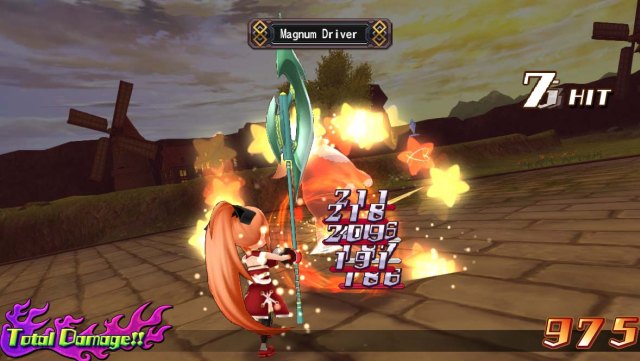
Each character has the standard RPG stats—Strength, Intelligence, and so on—but they also have weapon preferences, equippable skills and passive abilities. Battles are turn-based, but characters can move within a circular range before selecting an action. It's a lot like Quest 64, if anyone remembers that...classic. You can swap in "Standby" party members at any time, and Syrma has a ton of other specific options, such as unleashing an "Ultimate Soul" attack.
 Credit: Compile Heart/NIS America
The game just keeps throwing new systems at you, like a drunken party guest who can't tell when the other person wants them to stop talking. Skills can be used to "Blast Off" enemies and send them bouncing into each other, or flying into the sky. Doing so will sometimes break crystals, or you might accomplish the same feat with Fetish Poses. Either activity initiates Fever Mode, which combines well with Damage Carnival, which increases gained Experience, Money, and Mugen Points, which can be spent on various things in the Mugen Field, which is a 100-floor bonus dungeon, which... it just goes on and on.
Normally I wouldn't fault a game for adding more content, but this one goes so far over the top that it actually starts to feel tedious. I don't have 900 hours to spare on grinding for items or fusing classes together (you can do that too, by the way). These systems are reasonably fun and well-thought-out in their own right, but it's way too much to handle at once.
All of that invested time would have been better spent fixing the game's glaring issues. Most maps are overly simplistic and no fun to explore. Strange, uncharted planets feel more like pre-designed storage rooms for items and monsters. It doesn't help that the overworld abilities are only used to access previously unassailable chests. There are rampant framerate issues even though the visuals aren't very detailed, and the game once froze on me between battles in the Mugen Field. Apparently this is a common problem, and there's no worse place for it to happen than in the humongous bonus dungeon which only lets you save at specific intervals.
 Credit: Compile Heart/NIS America
Despite all of this, Mugen Souls Z is actually much more organized than the first game. Little touches like battle animations you can finally skip, tools to speed up grinding, and the ability to scan enemies' skills and abilities make it a lot less of a chore than the original. There are also some big changes and additions to core gameplay mechanics, but sadly, those improvements still aren't enough.
One thing that remains unchanged is its predecessor's goofy sense of humour, which again is a highlight. In a way, Mugen Souls Z works better as an anime than an RPG. The characters are constantly arguing with each other, obsessing over themselves, and generally overreacting to everything going on around them. Sometimes they misinterpret simple social cues and derail the whole adventure. Other times there's no villain to begin with, so they invent one for fun. The writers knew which personality types would be the most incompatible, so they made sure to shove those characters into every situation together.
 Credit: Compile Heart/NIS America
A lot of this appeal can be blamed on the excellent Japanese voice acting (the English audio is pretty good, too, but most of the dialogue isn't even voiced in English). Many of the cast's veteran actors have also voiced characters in popular anime, which explains why they're able to represent all of the ridiculous personalities available in Mugen Souls Z. There's entirely too much dialogue, and the characters' antics get repetitive over time, but at least they're always fun to listen to.
Also, be warned: this game is really sexual. Almost all of the female characters wear revealing clothing (like, complete-lack-of-pants revealing), there are numerous hot spring scenes, tons of innuendoes, and Syrma's coffin extracts the other Gods' powers by molesting them with an unidentified sticky, slimy substance. Syrma's Fetish Poses (the replacement for Chou-Chou's "Moe Kills") allow her to transform into a variety of trope-y sexual personas (Sadist, Masochist, Graceful, and so on) to charm monsters. Once seduced, those victims are absorbed by the coffin and changed into Shampurus, the bunny-like creatures which enhance the Poses' "Charm Level" and power up your Gundam-like robot/spaceship. They're also usable as soap.
 Credit: Compile Heart/NIS America
Then there's the Clothing system. Ostensibly, Clothing is used to raise characters' stat upgrade percentages upon leveling up, but its real purpose is to dress up and down everyone in your party. Some combinations are pretty revealing, and the game makes no distinction between normally male- and female-only attire. Freshly created characters appear in their underwear by default (including males; there are no nudity double-standards here). The character viewer even lets you rotate them in all directions, in case you couldn't see their panties already. Spoilers: they're mostly white.
A bathing mini-game which involved soaping up and massaging your characters—even the underage ones—was actually removed from the game's North American release. Nippon Ichi's localization team despises censorship, so that choice probably says a lot about the content involved.
Mugen Souls Z fits a little too tightly into its niche. Only those who are part of that very specific demographic will be able to truly enjoy this game. Profile of a Mugen Souls Z fan: you love excessive numerical detail, aren't concerned with exploration, don't mind the lack of a deep or even coherent plot, and you watch so much anime that the creepy sexualization of young girls simply doesn't faze you anymore. If all the stars align, then yes, Mugen Souls Z will provide easily over a hundred hours of comical JRPG goodness. Most of it will be spent on side quests and extras, but that's because you're into that sort of thing.


